
The Context Engine
Physics-Grounded Intelligence for Mine-to-Mill Decisions
ContinuumOps is not traditional consulting and not a generic software platform. We deliver a physics-grounded diagnostic and monitoring system that turns mine-to-mill data into verified performance improvement priorities
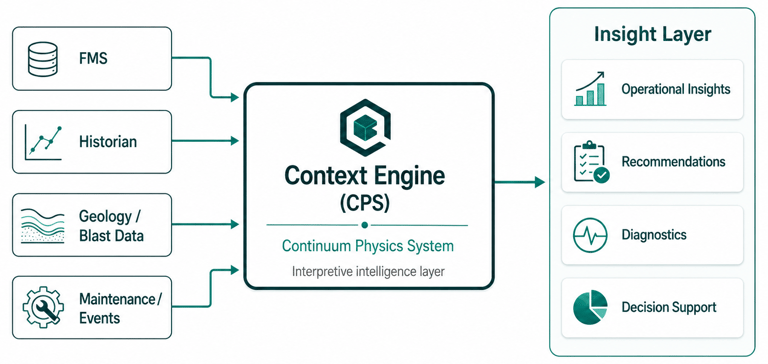
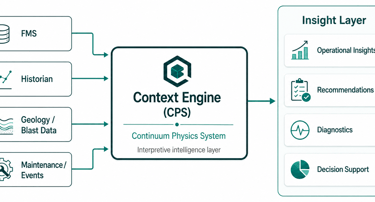
The Context Engine connects fleet, plant, geology, blast, maintenance, and operating data to identify where mine-to-mill value is being lost. It translates disconnected operational signals into a prioritised improvement roadmap, supported by physics-based analysis and Measurement & Verification.
As the benchmark library grows, the Context Engine can reduce diagnostic time and improve confidence across comparable ore types, equipment classes, operating modes, and constraints.
What is Context Engine?
The Context Engine turns raw mine-to-mill data into clear, practical insights. It helps teams understand operational conditions, identify performance opportunities, and make better decisions across the value chain.
It integrates with existing FMS platforms (Modular, Wenco, Jigsaw), plant historians (OSIsoft PI, AVEVA), and geological models without requiring system replacement, additional hardware, or new control architecture.
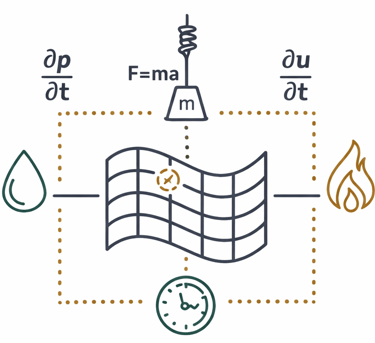
The engine applies continuum mechanics to treat blast, haulage, and comminution as a single energy transfer system measured in Total Specific Energy (kWh/t equivalent).
Integration with Existing IT/OT
Actionable Output:
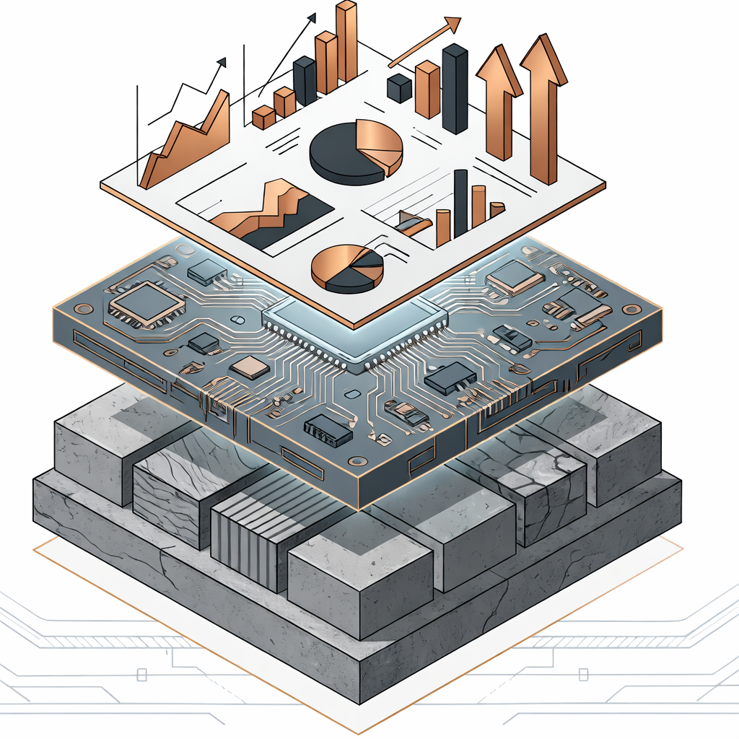
AI-Powered Operational Decisions
The Context Engine:
Complements Process Control Layers
AI-Driven Analysis (ML/GenAI)
Integrate Existing OEM/OT Data & Tools:
Explicit OT Integration
A Dynamic AI Intelligence Layer-Not a Platform
Five Core Automated Workflows

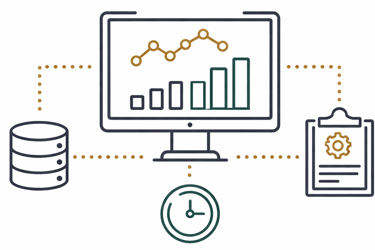
Auto-connects to Modular Dispatch, Wenco, or Jigsaw. Extracts payload data, cycle times, and fuel consumption.
Connects to OSIsoft PI or Aveva. Extracts SAG mill power draw, ball mill power, throughput curves, and particle size analysis.
Runs continuum mechanics models. Traces energy application sequentially: blast → haulage → comminution.


Queries the database of anonymized outcomes. Derives confidence intervals from historical data.
Synthesizes analysis into a prioritized roadmap. Weights by historical success probability. By design, the CPS is vendor-agnostic and scalable.
Why this matters:
FMS Integration
Historian Integration
Physics of Continuum Analysis
Links fleet performance directly to downstream value, exposing haulage inefficiencies and reducing hidden cost leakage.
Why this matters:
Connects mining variability to plant performance, enabling coordinated mine-to-mill optimization instead of siloed decisions.
Why this matters:
Identifies structural energy losses across blast-to-mill, unlocking improvement beyond surface-level KPIs.
Benchmark Comparison
Recommendation Generation
Why this matters:
Provides evidence-based prioritization, reducing execution risk and increasing confidence in improvement decisions.
Converts diagnostics into a clear, prioritized roadmap focused on measurable value realization.
Why this matters:
How The Context Engine Works
The Compounding Effect
The Context Engine compounds across four accumulated layers of intelligence. Each layer strengthens the next and improves delivery speed, margin, and certainty.
The Four Context Layers
Layer 1: Physics Context
What it provides:
Continuum mechanics framework treating blast-haulage-comminution as one energy transfer chain, measured in Total Specific Energy (kWh/t equivalent)
How it compounds:
Refined with each ore type encountered; calibration curves improve as the engine processes more geological variability.
Competitive Moat:
Cannot be replicated from data alone. Requires domain expertise encoded as physics models, not statistical correlations
Layer 2: Operational Context
What it provides:
Site-specific constraint mapping: equipment config, control philosophy, geology, terrain, workforce capability, regulatory environment
How it compounds:
Each OPD maps a unique operational fingerprint. The engine accumulates operational patterns across diverse mine configurations
Competitive Moat:
Institutional knowledge that tier-1 consultants lose when personnel rotate. The engine retains it permanently
Layer 3: Benchmark Context
What it provides:
Anonymised calibrated benchmarks: fragmentation efficiency curves, haulage cycle relationships, energy reduction curves by ore type and equipment class
How it compounds:
Engagement 1: baseline. Engagement 5: comparative. Engagement 11: predictive. Confidence intervals narrow with every data point
Competitive Moat:
Proprietary benchmark database that no competitor can access without doing the engagements. This is the core defensible asset
Layer 4: Trust Context
What it provides:
Physics-grounded explainability that operators recognise as credible. Every recommendation is traceable to continuum mechanics principles, not opaque algorithms
How it compounds:
Validated outcomes from prior deployments reinforce trust with each new customer. Published results become proof architecture
Competitive Moat:
AI startups cannot manufacture this. It requires demonstrated physics literacy and operator-level credibility built over the years
Economic Progression
The Context Engine improves with use. Delivery time declines. Analytical certainty increases. Margins expand.
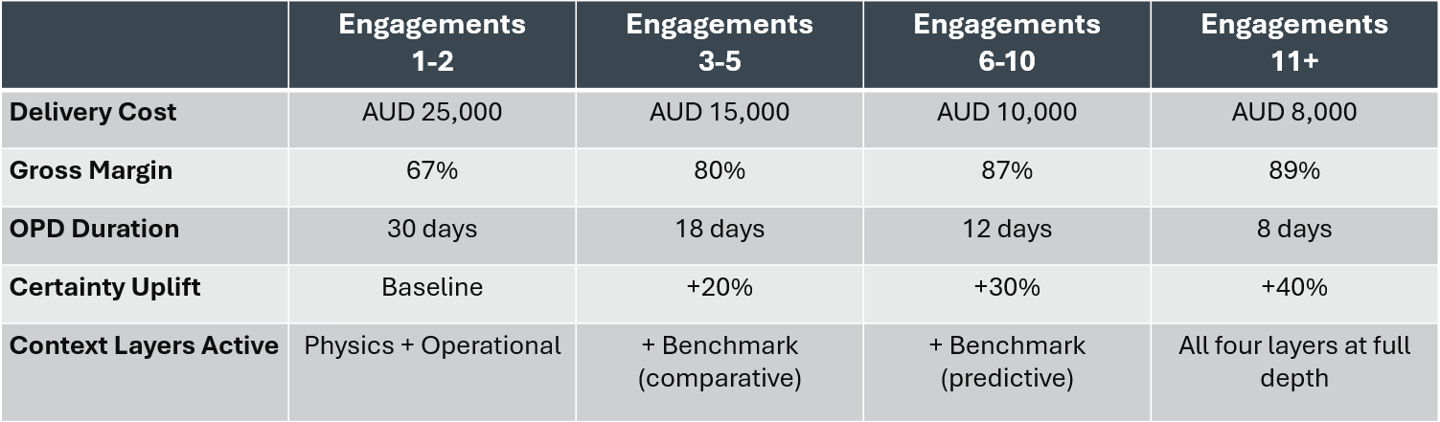
Unlike consulting models, analytical cost declines as contextual intelligence accumulates.
Insight Layer
12-month context-aware monitoring
Real-time integration with FMS and historian data
Automated verification against physics-based predictions
Verified uplift calculation for gain-share and reporting

The Context Engine supports:
Typical performance outcomes include:
10-20% throughput improvement
5–15% energy intensity reduction
Documented >US$300M free cash flow uplift in large-scale deployment
Deployment Path
The Context Engine deployment begins with the Operational Performance Diagnostic (OPD), ensuring every implementation is grounded in quantified opportunity and site-specific physics.
Phone
info@continuumops.com.au
+61 (07) 3870 9609
© 2026. ContinuumOps. All rights reserved.
Why ContinuumOps
Proof
About

How It Works
ContinuumOps Chile:
Marchant Pereira 150, oficina 901, 8390059 Providencia, Región Metropolitana, Chile
ContinuumOps Australia:
5 Moorak Street, Taringa, QLD 4068, Australia
ContinuumOps USA:
6253 Kilmer Loop, Arvada, CO 80403, USA